RFID tags seem simple on the surface, but beneath that exterior lies a sophisticated blend of components that critically determines your project's success or failure. This guide demystifies the internal makeup of an RFID tag.
Introduction
RFID tags seem simple on the surface -- a small label, a sticker, a seemingly innocuous piece of technology. But beneath that exterior lies a sophisticated blend of components that critically determines your RFID project's success or failure.
Ever wonder why one RFID tag reads flawlessly across a warehouse, while another struggles to be detected even a few inches away? Why do some work on metal and others don't? The secret lies in its fundamental internal components.
Many businesses struggle with RFID implementation because they don't understand why certain tags work better than others in specific scenarios. This guide will demystify the internal makeup of an RFID tag, explaining each element and how it directly influences key performance factors like read range, frequency, size, and application suitability.
Armed with this knowledge, you'll be empowered to make smarter purchasing decisions for your company and ensure your RFID investment pays off.
The Anatomy of an RFID Tag: Your Guide to Key Components
Every RFID tag, from the tiniest NFC sticker to the most robust UHF label, is built around a few essential elements. Understanding these is the first step to choosing wisely.
1. The RFID Chip (Integrated Circuit / IC) -- The Brain
The RFID chip is the true "brain" of the tag. It's a tiny microchip that stores data, performs computations, and communicates with the RFID reader.
How it Influences Your Project:
| Factor | Impact |
|---|---|
| Data Capacity | How much information can be stored (e.g., a unique product code, expiry dates, manufacturing data) |
| Read/Write Capabilities | Is the tag read-only, write-once-read-many (WORM), or fully rewritable? |
| Security Features | Some chips offer advanced encryption or authentication protocols |
| Frequency Compatibility | Each chip is designed to operate at a specific frequency (UHF, HF, or NFC) |
| Cost | Different chip functionalities and capacities come with varying price points |
Common chip manufacturers include NXP, Impinj, and Alien Technology -- each offering different performance characteristics and price tiers.
2. The Antenna -- The Voice and Ear
The antenna is what enables the RFID chip to communicate. It's typically made of etched copper, aluminum, or silver ink, forming a specific pattern designed to:
- Collect energy from the reader's signal
- Radiate its own signal back to the reader
- Enable communication over varying distances
How it Influences Your Project:
- Read Range -- This is one of the most significant impacts. Larger, more efficiently designed antennas generally result in longer read ranges
- Directionality -- Some antennas are omnidirectional (read from many angles), while others are more directional
- Frequency Specificity -- The antenna's design is highly tuned to its operating frequency. A UHF antenna looks very different from an HF or NFC antenna
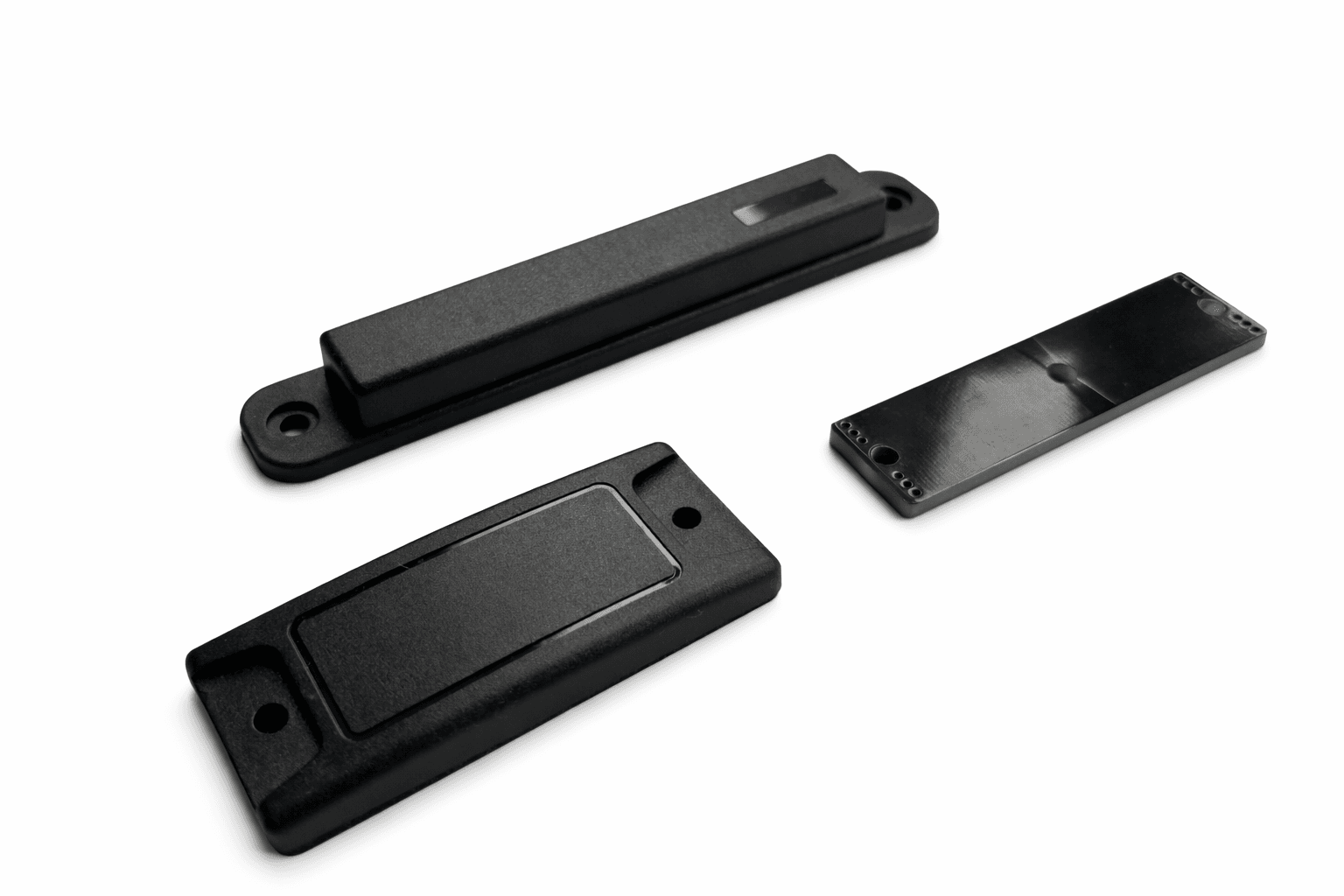
- Material Interaction -- The antenna's performance can be severely impacted by proximity to metals or liquids. Specialized "on-metal" tags feature unique antenna designs to overcome this
- Tag Size -- The antenna's physical dimensions often dictate the overall size of your RFID label
Pro Tip: If you need long read ranges (8+ meters), always look for UHF tags with optimized antenna designs. For close-range item-level tagging, HF/NFC antennas are more compact and cost-effective.
3. The Substrate (Inlay Material) & Adhesive -- The Foundation
This refers to the base material (often a thin PET film) on which the chip and antenna -- collectively known as the "inlay" -- are mounted. The adhesive is then applied to attach this inlay to the item you wish to track.
How it Influences Your Project:
- Durability & Environmental Resistance -- The substrate protects the delicate inlay. Options range from standard paper-thin films to robust plastics that withstand:
- Extreme heat and cold
- Moisture and humidity
- Chemical exposure
- Physical abrasion
- Flexibility vs. Rigidity -- Some applications require labels that conform to curved surfaces, while others need rigid tags for extreme conditions
- Attachment Method -- The adhesive type is crucial:
- Permanent bond
- Removable adhesive
- Suitable for challenging surfaces (rough plastics, oily metals)
- Influence on Performance -- The material and thickness of the substrate can subtly affect the antenna's tuning and overall read performance
4. The Outer Material (Face Stock & Liner) -- The Surface & Protection
For RFID labels, this includes the visible surface layer (face stock) that can be printed on, and the release liner that protects the adhesive before application.
The face stock can be made from various materials:
Paper-- Cost-effective, good for indoor usePolypropylene (PP)-- Water-resistant, tear-resistantPolyester (PET)-- Highly durable, chemical-resistantSpecialty materials-- Tamper-evident, destructible, or coated for extreme environments
How it Influences Your Project:
- Printability & Aesthetics -- Determines if you can print barcodes, human-readable text, logos, or specific branding
- Protection -- Provides an additional layer of protection from physical abrasion, moisture, and UV light
- Application-Specific Features -- This layer can incorporate tamper-evident properties, destructible features, or specific coatings for waterproofing or chemical resistance
Why Understanding These Components Leads to RFID Project Success
Understanding these intricate details empowers you. No longer will you simply pick an "RFID label" -- you'll select a precisely engineered component that aligns perfectly with your operational needs and environmental challenges.
When you grasp these elements, you can:
- Avoid Costly Mistakes -- Prevent buying tags that are unsuitable for your environment (e.g., a standard tag for metal assets)
- Optimize Performance -- Choose tags with the right read range, speed, and reliability for your specific use case
- Maximize ROI -- Ensure your RFID investment delivers the efficiency gains you expect
- Troubleshoot More Effectively -- If issues arise, you'll have a better grasp of where the problem might lie
Whether you're tracking retail inventory, managing assets in a logistics hub, or streamlining processes in manufacturing, the right RFID tag construction is foundational.
Quick Reference: Component Comparison
| Component | Primary Role | Key Selection Factor |
|---|---|---|
| Chip (IC) | Data storage & processing | Data capacity, security, frequency |
| Antenna | Communication with reader | Read range, size, material compatibility |
| Substrate | Structural foundation | Durability, flexibility, environment |
| Face Stock | Surface & protection | Printability, weather resistance |
| Adhesive | Attachment to items | Surface type, permanence, temperature |
Make the Smart Choice with LanTags
Armed with this knowledge, you're ready to make informed decisions for your RFID project. But navigating the vast array of options can still be challenging.
At LanTags, we simplify this complexity. With our team's over 7 years of collective experience in the RFID industry, we're not just selling labels -- we're guiding you to the right solution.
We offer full customization options for our RFID labels directly on our website, ensuring you get the exact specifications for your unique application:
- Specific chip types
- Antenna designs
- Durable materials
- Custom printing
Our commitment is to provide the best advice and competitive pricing on high-quality RFID labels, designed for your success. We help you translate your operational needs into the perfect RFID tag.
Explore our range of customizable RFID labels today and let our expertise work for your business. Need help deciding? Our team is ready to assist you in finding the ideal tag for your project!